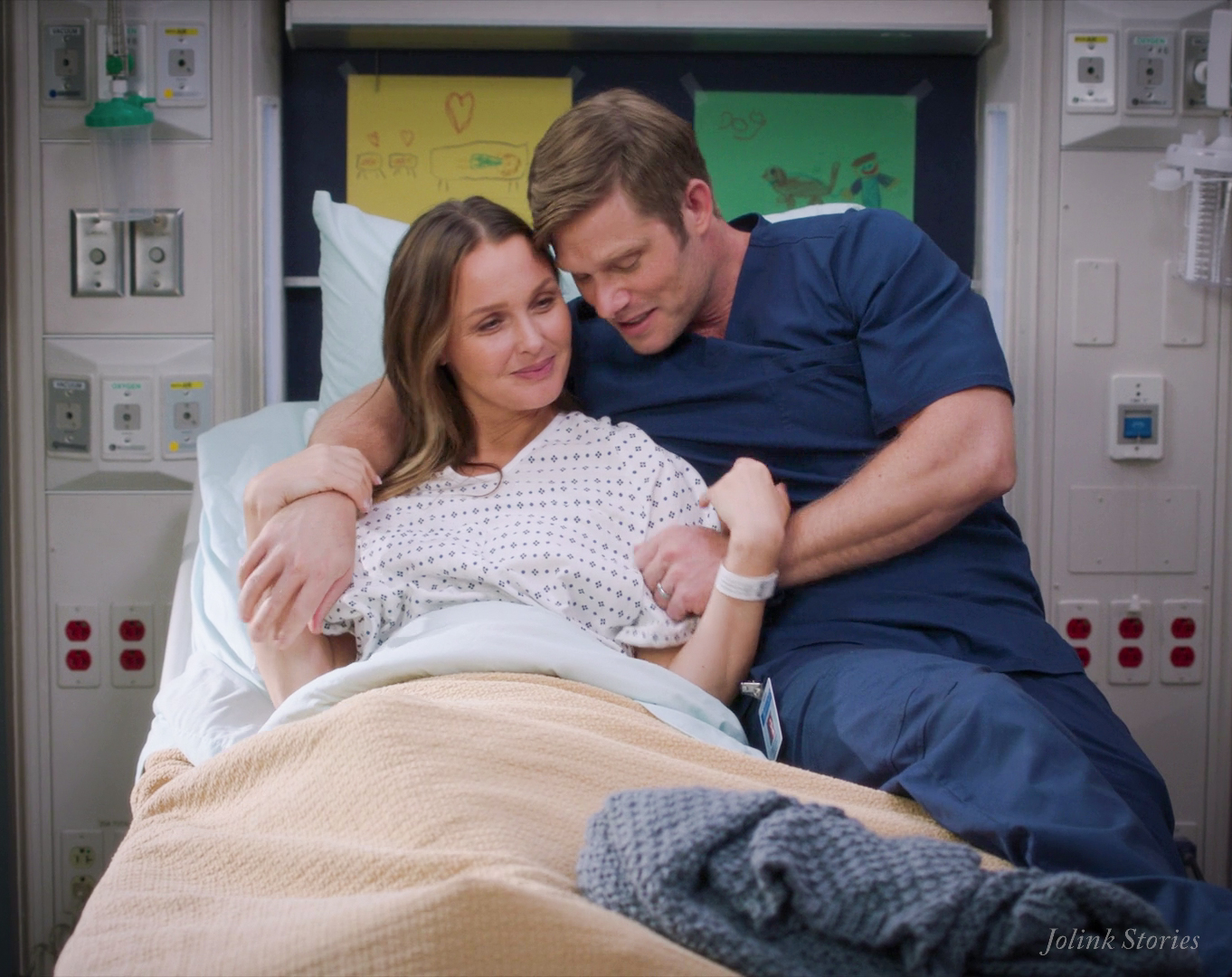
There is so much to say about this episode as a whole, but I’ll put my JoLink glasses on first.
Let’s be honest: this episode (and we did too) needed Jolink’s tenderness, that soft, loving dynamic we have been longing for for a long time. The kind that calms the nervous system. The kind that lets us breathe again.
Coming right before another four-week hiatus, my expectations were high. And since the previous episode didn’t include Jo and Link at all, I was genuinely anxious about whether we’d see them here. Not including them before such a long break would have felt unforgivable. So yes, I expected them to be part of this episode.
Thankfully, they were here.
And more than that, they were the emotional balm of the episode. The softness. The calm. The sense of safety we’ve been craving after weeks of crisis, fear, and suspended breath.
And what I didn’t know going in was where their story would pick up.
Another time jump?
A deeper exploration of Jo’s breakdown?
A focus on the twins’ health?
What about Link’s recovery?
Visually, the answer is immediate. Jo is glowing compared to the previous episodes. She’s up, standing, no longer tethered to monitors. That alone tells us time has passed.
Medically, it tracks. Preemies born around 32 weeks with respiratory support are typically discharged after four to six weeks. Jo’s own recovery timeline aligns with that as well.
That’s a huge narrative and emotional gap. One filled with adjustment, slow healing, and the fragile transition from survival to living, from constant fear to the first hints of peace. It’s a stretch of time I’m very much looking forward to exploring in the missing scenes.
Jo and the Fear of Going Home
Ndugu clearing Jo to go home was emotional. That’s something they’ve been waiting for weeks now. The scene approaches it lightly (no more hospital food, no more hospital bed), but we know it runs much deeper than that. Life is about to resume.
Link being cleared to return to surgery reinforces that feeling. For the first time in weeks, the future is opening again.
What I loved most was how supportive Jo was when Link asked if she was okay with him seeing patients. That moment mattered. It showed trust, partnership, and emotional attunement. They understand what matters to each other. They function as a team.
But when Jo learns that the babies are being discharged too, everything hits her at once.
Link reframes it joyfully: our whole family is officially out of the hospital.
Jo’s reaction, though, felt painfully honest. Deeply human. And incredibly relatable.
Going home means freedom.
But it also means responsibility.
It means the safety net disappears.
No monitors.
No hospital staff to look after them.
No constant reassurance.
No days structured by hospital routines.
You step out of the bubble.
And suddenly, it’s just you, your fear, two fragile newborns. And two other children with their own needs.
For Jo, who has spent weeks surviving crisis after crisis, that transition isn’t relief at first. It’s whiplash. She hasn’t had time to mentally prepare for normal life again. The unfinished nursery. No night nurse yet. Loose logistics. It may sound material, but it isn’t. It’s the surface expression of emotional overload.
And we know this about Jo: she needs control to feel safe. By the end of the episode, we see her grounding herself again, finding names of nurse’s aides, putting structure back in place. She’s not magically fine. She’s regulating.
And that felt true.
Link’s Recovery: Not Failure, but Misalignment
As much as I love Jo’s storylines, I was glad the episode leaned into Link’s journey.
For much of the season, Link has been the support system. His recovery has lived in the background. Here, we finally see the cost of that.
Being cleared doesn’t mean being healed.
Watching him confront his physical limitations was painful and narratively effective. The pep talk he gives the stripper is classic Grey’s mirroring. He’s talking to himself.
Don’t let one setback derail your dream.
You heal. You recover. You practice.
You belong on that stage.
Yes. Link belongs in the OR.
Just not now.
What makes this arc work is that his setback isn’t framed as failure. It’s framed as misalignment. Surgery is how Link defines himself. It is how he contributes, how he feels useful. Realizing that he’s not ready challenges his identity, not just his body.
I also really appreciated how Simone reads that struggle (both physical and mental) and subtly helps him through surgery without making him lose face. She meets him where he is, offering support without exposure, which makes the moment feel even more humane and selfless.
Family Leave: A Reorientation, not an Escape
The scene where Link joins Jo in the NICU and says he doesn’t want to stagger his leave, that he wants to take it now, was deeply moving. Jo’s reaction says everything. You can see on her face how much it means to her, how deeply she feels loved and chosen in that moment.
Some people believe he was lying to Jo, using paternity leave to avoid admitting his shoulder still hurts. I don’t read it that way at all.
Yes, he’s avoiding the full truth of his pain, but that avoidance isn’t strategic or calculated. The pain isn’t the reason for his decision. It’s not why he takes leave. It’s what helps him realize he should.
He’s been longing to return to surgery. But in that moment, he understands that what he needs, what they need, is family.
“We’ve been through so much.” That line reframed everything.
Choosing family leave isn’t him giving up or hiding. It’s him choosing the right priority at the right time. Jo. The babies. Luna and Scout.
The physical pain is just the catalyst, not a secret wedge growing between them, not something meant to destabilize their relationship. At least, that’s not how I read it at all.
Finally the Visual Confirmation of a Family
The last scene was pure warmth, and we needed it.
Because we don’t see Luna and Scout often, it’s easy to forget how fully formed their family already is. Seeing them hold one of the babies made everything real. This isn’t just a blended family anymore. It’s a whole one. And the fact that the twins are their biological children finally seals that reality on screen.
Hearing Jo say, “Daddy’s coming home with us,” genuinely melted my heart. It’s the first time we hear that on screen, even though I’ve been exploring this territory in my missing scenes.
Seeing the babies healthy. Seeing Jo and Link tender with each other. It softened something that’s felt heavy for a while. You could feel the love again. And more than that: the peace.
And that song, Soft Season by Raye Zaragoza, was the perfect choice.
After so much sustained tension, that softness felt earned.
Soft season.
Let the light sink.
Find peace in the stillness of receiving.
Watch it glow.
Stepping back from JoLink, there is still a lot to say about this episode. I don’t usually go into this much detail on other storylines, but here it felt necessary. Rather than covering the episode exhaustively, I’m focusing here on the storylines that felt the most significant to me.
Episode 10 was heavily marketed around Addison’s return, alongside Amelia’s. With that kind of promotion, it was hard to know what expectations would be met or left unmet.
Addison’s Return: High Expectations, Limited Impact
Addison is a character I’ve grown to love deeply. Her Season 19 arc remains one of the strongest in recent Grey’s history. It wasn’t drama for drama’s sake. It was grounded and painfully real, directly reflecting the reality following the overturning of Roe v. Wade. And that’s where Grey’s excels.
So when it was announced during the hiatus (right after the “Jo’s life hanging in the balance” cliffhanger) that Addison would return in Season 22, many assumed she was coming back for Jo and the babies. I never believed that. The timing didn’t make sense. I was confident Jo’s storyline would be resolved before Episode 10.
That said, I won’t lie: I would have loved to see Addison and Jo interact. The queen of OB and maternal-fetal medicine alongside the woman who, in my mind, feels destined to follow in her footsteps one day. That mentor-to-successor dynamic is something I’ve long hoped to see. But for this episode, I hoped for it without expecting it.
What I did expect was a return that carried narrative weight.
And that’s where my disappointment lies.
Addison’s presence felt oddly contained. She barely interacted with anyone besides Amelia.
And that’s the issue: Addison isn’t just a guest star. She carries emotional history, moral authority, and institutional memory within this hospital. When she shows up, her presence should have had wider narrative impact and should have been felt beyond a single storyline. Instead, it felt isolated.
Even her storyline struggled to land emotionally, eclipsed by the abrupt announcement that Jake is leaving her because he no longer supports her work on the PRT (the Physician Response Team vehicle repurposed as a traveling treatment center for reproductive health needs across the country). Bringing back a fan favorite only to destabilize her personal life felt unnecessary, even gratuitous.
What frustrated me most wasn’t the sadness of it, but the feeling that Addison was used more as an emotional and narrative device than as the layered character with so much history that she is. Dropping this revelation out of nowhere, primarily to push Amelia back into surgery, didn’t fully land for me. Even narratively, the connection felt rushed. Why would Amelia accept this simply because her friend is having a difficult time at home?
I understand the intention behind the role-reversal. Amelia has taken time, she appears to be more stable now, and the idea of her being the grounded one is interesting. But this didn’t need to be definitive. This could have been framed as a difficult moment, a crossroads, rather than an irreparable fracture. Amelia helping Addison see Jake’s perspective while still supporting her would have felt far more coherent, and far more respectful to both Grey’s Anatomy and Private Practice fans.
The phone call with Richard was sweet. Webber remains a grounding presence. But I couldn’t help wishing Addison had interacted with more people. She’s a pillar of this hospital. Narratively, it would have made sense for people to gather around her, to reconnect.
That sense of bond.
The same bond we saw in Episode 7, when everyone gathered around Jo and Link. That ensemble energy. The feeling that this hospital is more than coworkers, that it’s a family.
That’s what I missed here.
Where has Amelia been?
This also raises another issue: Amelia’s absence.
After all this time, we’re still given almost no context. Where has she been? Has she traveled? Has she helped Jo and Link? Has she been caring for Scout? Or has she been baking for three months?
I know Grey’s often asks us to fill in the gaps — trust me, I’m very used to doing that (that’s the whole point of this blog) — but this time, we needed more. A few lines of dialogue would have made all the difference. Without that context, Amelia’s arc and her character feel deeply weakened.
What Worked Beyond JoLink
Despite my frustration with Addison’s arc, I genuinely liked the episode as a whole.
One storyline that particularly resonated with me was Katie’s. By this point, we (just like Lucas) have grown to care about her.
Watching hope return as her treatment works, only to have it ripped away by funding cuts, felt heartbreakingly real. This isn’t rare. It’s systemic. It happens to people every day. And that’s what made it hurt.
Lucas’s reaction hit just as hard. He wasn’t only losing a patient’s future. He was confronting the weight of having pushed someone to dream again, only to watch that dream collapse. Guilt. Attachment. Helplessness. That storyline worked beautifully.
And Now, Another Hiatus
Now we’re heading into another four-week break.
I’m sad, of course, but also strangely grateful. It gives me time to finish Batch 22.7 and 22.8 (they’re very dense, so bear with me. It will be worth the wait).
Time to breathe. Time to let the story breathe.
And for once, we’re not holding our breath in fear for Jo and Link.
We’re turning toward hope.
Toward peace.
And that feels good.
Leave a Reply