Here we are. The finale finally aired.
And I have to admit, I approached it with a mix of anxiety and nostalgia already settling in. Because finales always mean endings. The end of a season. The beginning of a long wait before seeing these characters again.
I’ll say it right away: the finale absolutely delivered. Honestly, it exceeded my expectations, though in a quieter, more emotional way than I anticipated.
And a lot of that comes down to Meg Marinis.
Season finales are some of the hardest episodes to write. You have to resolve characters’ arcs, plant seeds for the future, and still deliver an emotional impact strong enough to leave people desperate for more.
This finale had the additional challenge of closing Teddy and Owen’s chapter in a way that felt satisfying to longtime viewers while remaining true to the characters, all while launching new emotional trajectories for almost everyone else.
And somehow, it managed to do both.
There was a lot happening, but it never felt overcrowded. Everything revolved around one central catastrophe: the bridge collapse. Every storyline orbited around it. Everyone experienced their own version of that day, carrying their own fears, struggles, and unresolved tensions into the crisis.
Eventually, the bridge collapse became more than a catastrophe: it became the emotional catalyst forcing everyone to confront something deeply personal.
And that gave the episode a real backbone.
We weren’t constantly being pulled in every direction from one dramatic beat to another. The episode gave us time to sit with each storyline. To engage emotionally. To breathe with the characters.
Every scene seemed to carry multiple layers at once: advancing the catastrophe, deepening character arcs, planting seeds for Season 23, and reflecting the larger themes of the episode: love, trauma, survival, and the fear of losing the people or things that matter most.
Each secondary storyline nested within the larger catastrophe had depth. The characters’ individual journeys either landed their season arcs emotionally or opened compelling doors for the next chapter.
Or both.
It had everything a Grey’s finale needs:
strong emotions, relationship development, personal struggles, meaningful medical cases.
And in many ways, that’s what Grey’s Anatomy has always done best:
using medicine as an emotional mirror for its characters.
Let’s start with Jo and Link before moving into the other storylines.
Jo and Link — When Trauma Becomes Impossible to Ignore


This episode finally brought us to the emotional core of what the season has been circling around for weeks.
And what makes the storytelling so effective is that the medical case becomes the collision point for both of their personal struggles.
Jo is brought onto a case involving a pregnant woman injured in the bridge collapse, forcing her to work side by side with Link on a trauma that inevitably mirrors their own experience: a 32-week pregnancy, a traumatic delivery, a mother and baby almost dying, all while Link pushes through physical pain he can no longer fully hide.
And through that case, the episode makes it impossible for either of them to keep ignoring what they’re carrying.
Jo’s Trauma Runs Deeper Than Expected

She is not okay. At all.
And it goes far beyond what I was anticipating.
I thought her trauma was specifically tied to OB, and that the storyline would eventually lead her back toward general surgery. But this episode makes it clear that the wound runs much deeper than that.
By the end of the episode, she openly admits she’s not even sure she can practice medicine anymore.
My jaw genuinely dropped when she said that.
Because for the first time, the show stops framing this as a temporary struggle and acknowledges how deep the damage really goes.
In that moment, the full weight of what she’s been carrying finally becomes impossible to ignore.
And while it hurts to hear her say it, I’m genuinely glad the show is telling this story. Because postpartum trauma, especially after catastrophic deliveries, is not something that magically disappears overnight.
The show refuses to brush that reality aside. And that matters.
It acknowledges that surviving something traumatic doesn’t automatically mean you know how to emotionally return to your life afterward. Especially when the very thing you love becomes inseparable from the worst moment of your life.
And I’m really glad the show chose not to simplify that healing process.
You could feel Jo unraveling throughout the episode. In the ER, something about her felt deeply off. The way she spoke. The tension underneath every interaction. It felt like controlled panic. High stress barely being held together.
And Link sees it immediately.
Because he knows her better than anyone.
That’s what makes the moment before surgery so heartbreaking.
He keeps trying to reach her because he clearly sees she’s struggling. But Jo, when she’s overwhelmed, shuts down and pushes him away. Talking about it would mean fully confronting her fear. And if she lets herself feel it, she’s terrified she won’t be able to do her job and save this woman. She cannot afford to emotionally collapse before entering that OR.


So instead, she pushes through.
And because Link is the person she feels safest with emotionally, he becomes the one absorbing the pressure she’s trying hardest to contain.
That felt painfully realistic.
What does that mean for Jo moving forward?
Will she stop practicing medicine altogether? Honestly, I don’t think so.
And selfishly, I don’t think I want to imagine a world where Jo Wilson is no longer a doctor.
But before she can ever truly return to herself, there’s clearly a real healing process ahead of her. She may have managed to push it aside these past few months, but after this episode, it feels impossible for her to keep avoiding what’s now right in front of her:
she needs help processing everything that’s happened to her.
Link Fails at Holding Everything Together
And then there’s Link.
This episode reminded me exactly why I fell in love with this character in the first place.
Because while Jo is visibly unraveling, Link is quietly doing the opposite:
holding himself together at all costs.
That’s who Link has always been.
The caretaker.
The one who pushes through.
The one who always puts everyone else before himself.
And this episode finally starts questioning the cost of that.
The ER scene says everything. The way he pushes himself beyond his physical limits while forcing open the patient’s pelvic ring. The way he looks at Jo while doing it. The silent understanding that he cannot fail here because Jo emotionally needs this mother and baby to survive.


That broke my heart.
Because beneath all of it, Link is still injured. He is still recovering from his own trauma after almost dying in the explosion.
And while the season mostly focused on the physical aftermath of the explosion for him, it’s hard not to feel like some of the emotional trauma is still sitting underneath all of this too.
But unlike Jo, whose trauma is beginning to surface outwardly, Link’s instinct is to suppress his own pain and stay functional.
The moment where he secretly takes pain medication and lies about it (“just a headache”) changes everything.
Because suddenly we understand that this isn’t minor discomfort anymore.
He’s still suffering, more than he can admit to Jo, while trying to convince himself he can manage it alone.

And honestly, it makes complete sense for his character.
Link has always struggled with vulnerability when it comes to himself. After spending part of his childhood dependent on other people because of his illness, adulthood became tied to the idea of being strong, capable, and self-sufficient. He learned to associate strength with being the person who takes care of everyone else, not the person needing help.
Which makes his behavior throughout the episode feel painfully consistent with who he’s always been, especially because Jo is barely holding herself together.
In his mind, his own pain becomes secondary.
If one of them gets to fall apart, it cannot be him.
Because there’s a tragic irony underneath all of this:
Link desperately wants Jo to open up to him while simultaneously hiding the full extent of his own suffering from her.
And what makes it even sadder is that he did open up earlier this season about the fact that his shoulder still wasn’t healing properly.
But now that Jo is barely holding herself together emotionally, he slips back into silence.
And Jo, overwhelmed by her own trauma, can no longer fully see the extent of what he’s carrying either.
He thinks he’s protecting her by carrying it alone.
But the episode quietly plants the question:
how long can someone keep carrying everything before it finally collapses under its own weight?

The show is very clearly planting the seeds for something deeper here.
And Meg Marinis hinted in interviews that this won’t necessarily become a stereotypical addiction storyline, but something more nuanced: a story about denial, masculinity, and the danger of convincing yourself you can keep powering through indefinitely.
And we all know eventually that strategy collapses.
And honestly, that’s both what scares me most and what excites me most heading into Season 23.
Because that makes for great storytelling. The emotional material here is incredibly strong: raw vulnerability, emotional repression, and the need to appear strong at all costs.
And Chris Carmack has repeatedly proven how powerfully he can carry that kind of storyline.
The Ending Scene — A Mix of Love, Relief, and Silent Damage

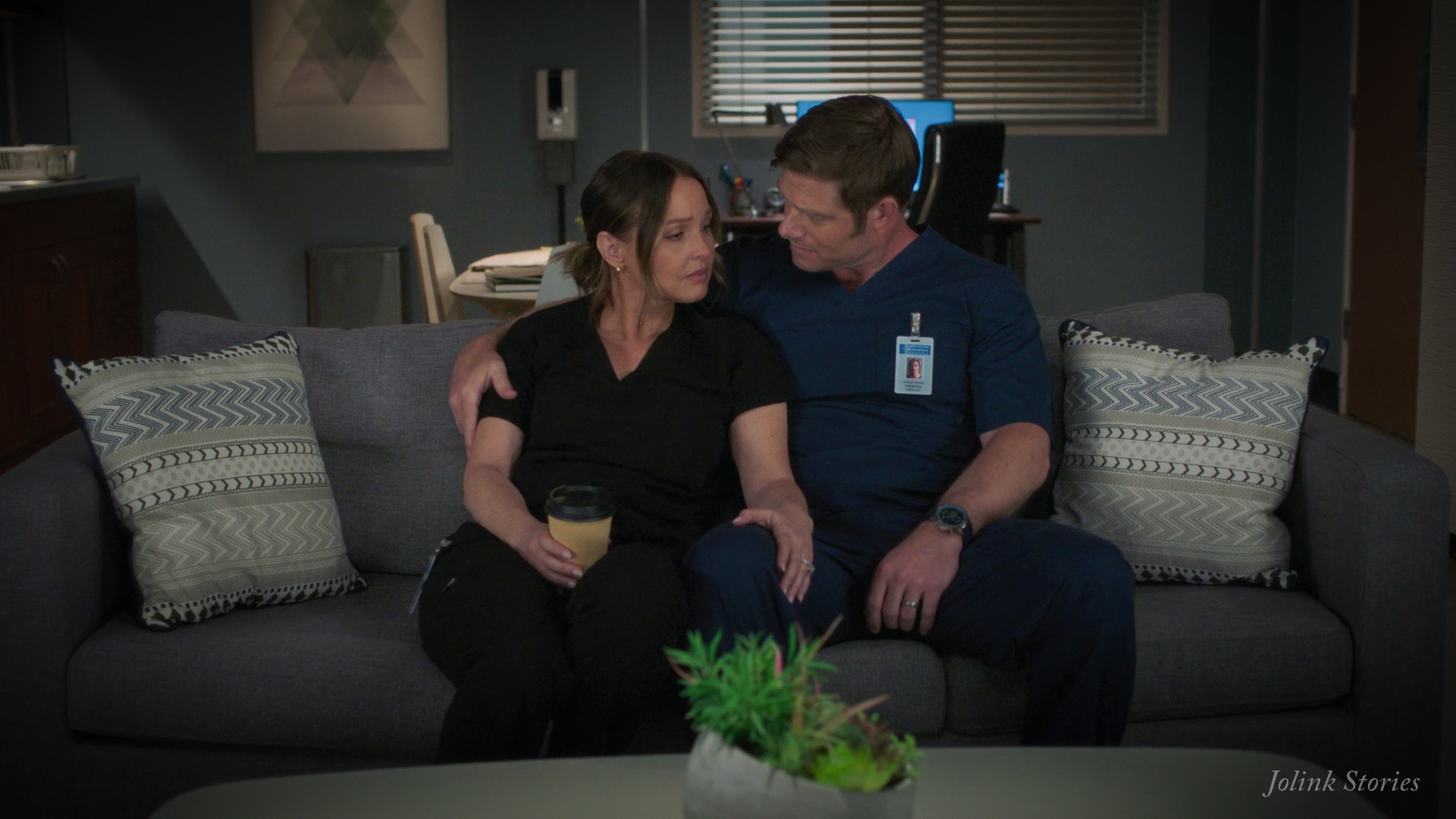
The final JoLink scene was beautiful and devastating at the same time.
A balm on our wounds and a quiet stab to the heart.
Seeing Jo finally admit that this goes beyond simply questioning OB felt huge. She finally says out loud what she’s been terrified to confront internally: she may not want to practice medicine at all anymore.


And Link’s response was exactly what she needed.
No pressure.
No judgment.
No trying to fix her.
Just: “I’ll support you no matter what.”
Whether she leaves OB.
Whether she leaves surgery entirely.
Whether she needs time.
He’ll take care of them.
That scene felt like an emotional exhale after episodes of pressure building underneath the surface.
Her “I love you” sounded almost like relief.

And then there’s the final image:
Jo holding his hand as she leaves, unknowingly hurting his shoulder while he silently pushes through the pain, before quietly reaching for another painkiller the second she’s gone.
What a beautiful directing choice.
Because in a single gesture, it visually captures where they both are emotionally right now:
Jo finally leaning on him.
Link quietly hurting himself while trying to hold everything together.
That’s what makes them such a compelling couple to watch.
They love each other deeply.
They trust each other deeply.
But they still struggle with letting themselves be fully vulnerable at the same time.
And honestly, that’s what makes their relationship feel so human.
This has been one hell of a season for them.
Painful.
Layered.
Emotionally raw.
And genuinely one of the strongest things the show has done with Jo and Link.
And that’s exactly why I’m so excited to see where Season 23 takes them next.
Meg Marinis hinted in interviews that both characters may ultimately need help navigating everything they’re carrying.
And in Jo’s case especially, the episode makes it feel increasingly impossible for her to continue processing that trauma entirely on her own. It’s hard not to feel like she’s reached the point where outside support is no longer optional.
And honestly, that feels not only realistic, but necessary.
Owen & Teddy — Choosing Each Other

Goodbye to one of Grey’s Anatomy’s most iconic couples.
I thought this finale handled Teddy and Owen beautifully, both individually and together.
Owen stepping into hero mode during the bridge collapse felt incredibly fitting for his sendoff episode. Honestly, I wouldn’t have expected anything less.
And I really loved the parallel created through his conversation with the father trapped at the scene. Hearing that man say his family was his life forces Owen to confront the same truth about Teddy and their children. Something he later finally says out loud to her.
Meanwhile, Teddy was exactly who she has always been:
a brilliant, commanding surgeon under pressure, while privately terrified of losing the man she loves.
The keychain reveal was honestly such a smart emotional beat. Teddy realizing Owen was alive because she recognized his crike keychain on a patient was such a beautiful callback to one of Owen’s earliest Grey’s appearances with the crike pen.
And the OR reunion scene genuinely moved me.
The look in their eyes said everything.
What I loved most, though, was the resolution itself.
Last season ended with Teddy telling Owen:
“I choose me.”
This time, she says:
“I choose us.”
But now, it’s no longer only about Teddy choosing Owen, but about Teddy and Owen finally choosing each other fully.
Owen chooses Teddy too. He offers to follow her to Paris with their family and let her pursue her career
After years of chaos, miscommunication, betrayals, trauma, and emotional whiplash, ending their story like this felt incredibly soothing.
Not like an ending, honestly.
More like a new beginning for them as a couple.
Owen has had highs and lows across the years, but that complexity is exactly what made him such a compelling character. Watching his evolution from traumatized military surgeon to the man, father, and doctor he became has been one of the show’s longest emotional journeys.
We’ve been frustrated with him at times.
Sometimes deeply.
But we also loved him for many more reasons.
Almost the way you love a complex family member.
And Teddy has been such an important representation of women in leadership throughout the years: a remarkable trauma surgeon, military veteran, mentor, and eventually chief.
She wasn’t perfect, but that’s also what made her deeply human.
I’m genuinely going to miss her yelling orders down Grey Sloan hallways like the absolute badass chief she is.
And honestly, Paris feels like a beautiful place to leave them for now.
Not an ending.
A new chapter.
And somehow, I don’t fully believe we’ve seen the last of them yet.
As for the goodbye party… I think it’s safe to assume they didn’t simply leave Grey Sloan after that shift without properly saying goodbye to the people who became family over the years. And honestly, that’s exactly the kind of emotional space I want to explore in my missing scenes. Especially because this season quietly leaned more into Teddy and Owen’s friendship with Jo and Link, showing they had gotten close beyond the hospital walls.
Miranda Bailey — Wanting a Voice in the System
I’m really happy with where Bailey’s storyline landed this season.
Because ultimately, her decision to pursue a Master’s in Public Health isn’t really about going back to school.
It’s about deciding she no longer wants to simply survive within a broken system.
She wants a voice in changing it.
That’s what makes the arc so satisfying.
All season long, Bailey has been frustrated by rules, bureaucracy, institutional failures, and the limitations imposed on doctors trying to do what’s morally right for patients.
And now she’s asking:
Why can’t I help shape those rules too?
Why can’t I be part of the conversation as someone who actually understands the human cost of these decisions?
I love that.
And honestly, it resonates deeply with me personally because career changes and returning to education later in life are terrifying, but also incredibly empowering.
There’s something genuinely beautiful about seeing someone at Bailey’s stage in life deciding she still wants to grow, evolve, and redefine her purpose.
That’s something to look up to.
And of course, even while benched, seeing her back in the OR helping save Nick felt deeply satisfying.
Because Bailey will always be Bailey.
And she will always show up to save the day.
Meredith & Nick — A Quiet Confirmation of Love

I’m not particularly emotionally invested in Meredith and Nick, mostly because we simply don’t see enough of them consistently anymore, and because Meredith herself almost feels tied to another era of the show for me.
But I thought this storyline was genuinely sweet.
Meredith proposing to Nick felt earned.
Not because the question of whether Nick would survive carried enormous suspense for anyone (come on… not twice), but because they’ve been circling around this for a long time now. We’ve known for quite a while that Nick was the one for Meredith.
And what makes the proposal work emotionally is that it doesn’t come out of nowhere. It comes from fear. From memory. From the possibility of loss suddenly becoming real again.
The moment Nick is brought into Grey Sloan, it inevitably echoes what happened to Derek eleven years ago. The episode makes that parallel impossible to ignore, especially when Amelia says it out loud to Cass: Meredith’s husband died because of incompetent doctors.
And suddenly, everything happening around Meredith carries a different emotional weight.
But unlike eleven years ago, Amelia is by her side.
Meredith is not going through it alone.
And almost losing Nick forces her to confront something she already knew deep down:
she doesn’t want to imagine a future without him in it.
The proposal ultimately feels like a quiet confirmation of something that already felt true. And honestly?
Those two deserve happiness.
Amelia & Toni — The Problem with Waiting
I have to say it: I will not blame Amelia for this situation.
Toni put Amelia in emotional limbo while trying to figure things out with her ex-wife. At some point, you cannot reasonably expect someone to wait forever while you decide whether you’re ready to choose them.
Meg Marinis herself said that Amelia genuinely believed Toni was going back to her ex. She wasn’t trying to hurt Toni. She was hurt herself. Sad. Rejected. And in that moment, Cass became a way to feel wanted again.
So Amelia seeking comfort elsewhere (Cass really does have a talent for appearing in messy situations) is not something I think she should be entirely condemned for.
What makes for great TV is that the timing is awful.
Because the moment Amelia finally lets go emotionally is precisely the moment Toni comes back ready to choose her.
What will ultimately determine whether I connect with Toni’s character next season is how she handles the aftermath.
Because if she turns around and blames Amelia for not waiting indefinitely, that would feel deeply unfair, and honestly selfish.
Especially when Toni herself created the uncertainty Amelia was reacting to in the first place.
Simone, Lucas, and Bryant — the Love Triangle, Again

Did I miss something?
I genuinely thought Simone and Bryant were in a relationship. Maybe it’s casual, maybe the boundaries were never fully defined, but I was still surprised by Simone’s apparent lack of guilt after sleeping with Lucas.
Because emotionally, the fallout barely seems to register for her at all.
And honestly… I really don’t want the show to fully fall back into the Lucas/Simone cycle again.
What surprised me most this season is actually Bryant.
I have such a soft spot for him.
He’s smart, funny, emotionally sincere even if it feels like he’s still hiding parts of himself. And Trevor Jackson brings such natural warmth to the role that it makes Bryant incredibly easy to care about.
So I genuinely feel bad for him.
And that’s what complicates the triangle for me.
Because Simone clearly underestimated what the relationship meant to him, while Bryant seems far more emotionally invested than she realized.
And he deserves honesty.
As for Lucas, I do think the season genuinely matured him. The Katie storyline changed him.
But one episode — and one night together — is not enough to magically erase everything that happened between them this season.
And honestly, I hope the show remembers that too.
Kwan — The Cost of Accountability

Well… Kwan.
I know this hospital has a long history of letting rogue doctors get away with almost anything, but honestly… what did you expect?
I’m genuinely glad the show is allowing actions to have consequences again.
For a moment, I was worried his firing would immediately be brushed aside because he helped during the bridge collapse response.
And historically, Grey’s has often leaned heavily into forgiveness when it comes to medical misconduct.
But this wasn’t really a mistake.
It was a conscious decision.
And honestly, now I finally understand why Richard reacted so strongly.
A few seasons ago, the residency program nearly collapsed entirely. They fought hard to rebuild its credibility, and Kwan’s actions directly threaten it.
So even if Richard has historically shown leniency toward certain doctors, this feels bigger than one resident making a bad call.
It’s about protecting the institution they spent years trying to rebuild.
So seeing real institutional consequences return actually adds needed tension back into the show, and honestly, makes for much stronger storytelling.
That said, I also don’t think this is necessarily the end of Kwan at Grey Sloan.
But I’m very curious to see where that conflict goes next season, especially if Catherine and Richard end up approaching the situation differently.
Because Catherine’s reaction definitely felt… interesting.
Jules & Winston — Something Unexpectedly Innocent

I realized after finishing my Episode 17 review that I completely forgot to talk about Jules and Winston.
Which is funny because my feelings about them have actually evolved a lot recently.
At first, I was hesitant. I wasn’t fully feeling the chemistry the way other viewers were, and honestly, I really disliked the messy situation with Iris when Winston and Jules first started hooking up.
Winston was still being framed as the “good guy” while emotionally crossing lines that absolutely felt questionable to me.
But these last few episodes softened me on them.
I’m still not fully obsessed with the pairing, but I do think they’re cute.
Not in an explosive, passionate way.
More in an oddly innocent way.
Almost like a high school relationship emotionally.
Now that Ben saw them leaving the on-call room, though, things are obviously about to get messier once their relationship becomes public knowledge.
Which opens interesting questions about power dynamics, career identity, and professional perception heading into next season.
That said, I do have to admit something:
Grey’s Anatomy has normalized attending/resident (even attending/intern) relationships so much over the years that I’m not entirely convinced by the idea of this becoming some huge scandal.
So I’m genuinely curious to see how the show plans to raise the stakes around them moving forward.
Looking Ahead to Season 23
What’s interesting about this finale is that, unlike last season, it doesn’t end on a massive life-or-death cliffhanger.
Emotionally?
Almost nobody is okay.
And honestly, I think that’s just as compelling.
Because the groundwork laid for next season is incredibly rich.
Judging from recent interviews, Meg Marinis clearly has long-term emotional trajectories planned for many of these characters, and the season premiere can’t come soon enough.
That said, I do hope next season focuses more deeply on the cast we already have instead of continuing to expand the ensemble further.
One of my biggest frustrations this year was simply not having enough time to fully sit with the characters, especially when so much of their emotional journey had to be inferred rather than truly shown on screen.
Too many characters inevitably means less depth for everyone, and a lot more emotional gaps for viewers to fill in themselves.
Guest appearances are great when they serve the emotional journeys already in place.
But the heart of Grey’s has always been character depth.
And right now, that’s where the show feels strongest.
Final Thoughts on Jolink
I’ll leave the deeper season retrospective for another article, because I have a lot more to say about the emotional journey Jo and Link went through this year, and what Season 23 might hold for them.
But overall?
This has been a genuinely strong season for them.
Not perfect. It left huge gaps for us to fill.
And I’ve been very honest throughout these reviews whenever something didn’t fully work for me.
But the story told for Jo and Link this season was layered, emotional, painful, hopeful, and deeply human.
It explored love, trauma, recovery, healing, fear, vulnerability, motherhood, and the quiet ways people try to protect each other, sometimes at their own expense.
And beyond the show itself, this season gave me something unexpected:
inspiration.
JoLink Stories was born from this season’s storyline.
From these emotions.
From these characters.
The storytelling this season gave me ideas, energy, and creative momentum I honestly didn’t expect. It gave me feelings and creative instincts I could no longer ignore.
So as the season ends, more than anything, I just feel grateful.
Thank you, Meg Marinis.
This season didn’t just make me emotional.
It made me want to create.
Leave a Reply